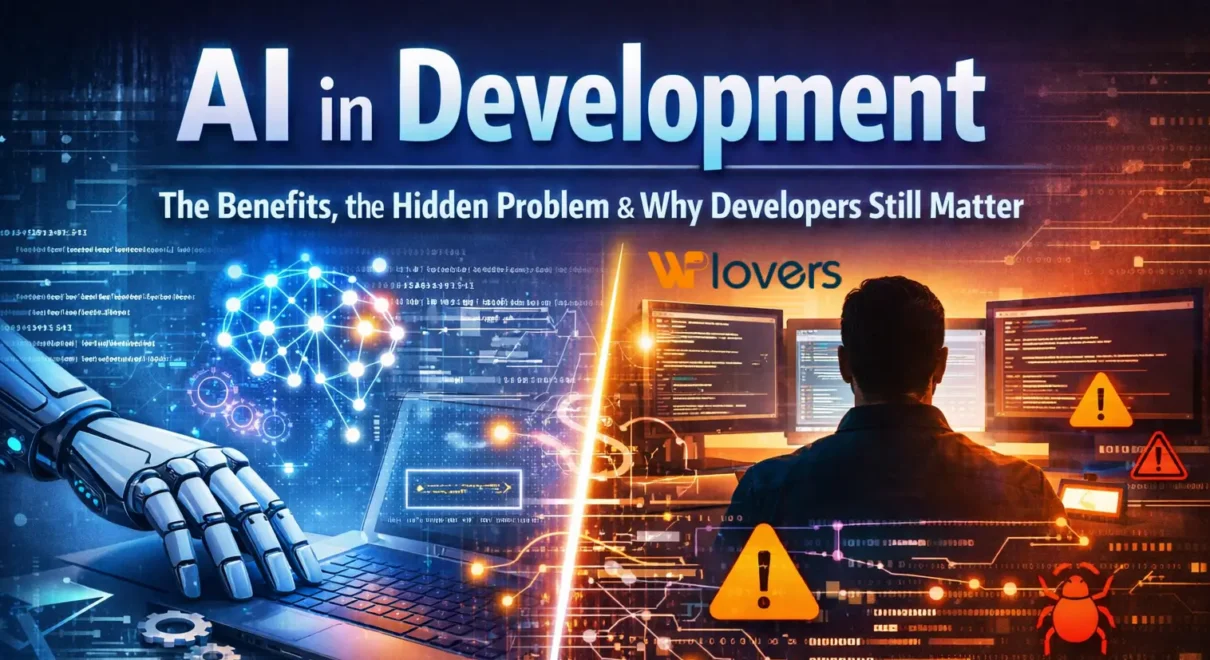
Artificial Intelligence has changed the way software is built.
Today, developers can use AI tools to generate code, speed up repetitive tasks, solve logic problems faster, write documentation, and even get help with debugging. What once took hours can now take minutes.
For startups, agencies, businesses, and individual developers, this feels like a major breakthrough.
And honestly, it is.
AI is helping teams move faster, reduce manual effort, and improve productivity in ways that were difficult to imagine just a few years ago. Whether it is creating a simple function, scaffolding a new feature, writing SQL queries, generating test cases, or helping with frontend structure, AI is now becoming part of the modern development workflow.
But there is a side of this trend that many people do not talk about enough.
The problem is not that AI writes code.
The hidden problem is that AI can write code that looks right, works for now, and still creates long-term issues for the project.
That is where the real discussion begins.
The Good Side of AI in Development
Before talking about the risks, it is important to understand why AI has become so valuable in development.
AI tools can significantly improve speed and efficiency. Developers can use them to:
- generate boilerplate code quickly
- build first drafts of features
- get alternative logic suggestions
- refactor repeated code patterns
- write unit tests faster
- create documentation
- troubleshoot errors
- explore multiple solution ideas in less time
This is especially useful when developers are working under deadlines or dealing with repetitive implementation tasks. Instead of spending extra time on routine coding, they can focus more on architecture, business logic, user experience, and decision-making.
In many cases, AI can act like a fast coding assistant that helps reduce the time between idea and execution.
That is a real benefit.
Used properly, AI does not reduce the value of a developer.
It increases the developer’s output.
The Hidden Issue No One Talks About Enough
The biggest issue with AI-generated development is not always visible in the first result.
Very often, AI-generated code:
- is longer than necessary
- repeats logic in multiple places
- uses weak naming conventions
- ignores project-specific patterns
- lacks scalability
- introduces performance issues
- misses edge cases
- does not fully consider security
- creates code that is harder to maintain later
At first glance, the code may seem correct because it runs and gives the expected output. But production-ready development is not only about “working code.”
Good development is about writing code that is:
- clean
- maintainable
- secure
- understandable
- optimized
- testable
- scalable for future growth
AI can help create a starting point.
But it does not automatically guarantee these qualities.
This is the hidden issue: speed can create the illusion of quality.
Just because something was generated quickly does not mean it is the best solution.
Working Code Is Not Always Good Code
This is one of the most important things businesses and even some junior developers may overlook.
If AI generates a function that works, many people assume the task is complete.
But experienced developers know that there is a big difference between:
- code that works today
- code that is safe and sustainable tomorrow
For example, AI might generate a long block of code with nested conditions, repeated queries, weak validation, or unnecessary complexity. It may solve the immediate task, but later:
- the feature becomes hard to update
- debugging takes longer
- performance drops under scale
- security risks appear
- onboarding new developers becomes harder
- future development slows down
In other words, a fast solution can quietly become expensive later.
That is why development should never be judged only by how quickly code is written.
It should also be judged by how well that code survives change.
Why Developer Review Is Still Essential
AI is powerful, but it does not replace engineering judgment.
A real developer brings things that AI alone cannot fully guarantee:
- understanding of project architecture
- awareness of business requirements
- performance considerations
- security best practices
- consistency with coding standards
- proper database and API design
- long-term maintainability thinking
- practical knowledge from real project experience
A developer does not just ask AI for code and paste it into production.
A good developer:
- gives clear prompts
- checks whether the output is logically correct
- reviews structure and readability
- removes unnecessary complexity
- optimizes the solution
- handles edge cases
- validates security concerns
- aligns code with the project’s real architecture
This is where the best results happen.
AI produces faster drafts.
Developers turn those drafts into reliable solutions.
The Prompt Is Not the Final Product
One mistake many people make is assuming that a good prompt automatically creates a finished product.
Good prompting definitely matters. In fact, better prompts usually produce better output. A skilled developer can guide AI more effectively by giving proper context, technical direction, and constraints.
But even with strong prompts, the result still needs human review.
Why?
Because development is not only about syntax or function generation. It also involves:
- trade-offs
- system design decisions
- project-specific context
- user behavior
- future extensibility
- deployment realities
- integration requirements
AI does not always understand the deeper context of a real production environment the way a developer does.
That is why prompting is powerful, but reviewing is mandatory.
AI Saves Time — But It Can Also Shift Time
This is another hidden issue many teams discover later.
AI often saves time in the beginning.
But if the generated output is not reviewed properly, that saved time may simply be moved to another stage.
For example:
- less time in writing code now
- more time later in debugging
- more time later in refactoring
- more time later in fixing performance issues
- more time later in handling maintainability problems
So the real question is not only, “Did AI save time?”
The better question is:
Did AI save time without creating future technical debt?
That is the difference between smart AI usage and careless AI dependency.
AI Is Best for Assistance, Not Blind Dependency
The strongest development workflow is not one where AI replaces thinking.
It is one where AI supports thinking.
Developers can use AI effectively for:
- first drafts
- repetitive logic
- code suggestions
- syntax help
- documentation support
- test generation
- brainstorming approaches
But critical decisions should still be made with human understanding.
That means AI should be treated as:
- an assistant, not an architect
- a helper, not a final reviewer
- an accelerator, not a guarantee of quality
This mindset helps teams get the best of both worlds:
speed from AI and reliability from human expertise.
The Risk for Businesses
This topic is not only important for developers.
It also matters for business owners, startup founders, and project managers.
From the outside, AI-generated development may look like a way to cut time and cost quickly. And in some cases, it can absolutely improve efficiency.
But relying on unreviewed AI-generated code can create hidden business risks:
- unstable product quality
- higher maintenance cost
- delayed releases later
- poor scalability
- security vulnerabilities
- inconsistent user experience
- increased dependence on future rewrites
A project that feels cheaper in the short term can become more expensive in the long term if the technical foundation is weak.
That is why businesses should not ask only,
“Can AI build this faster?”
They should also ask,
“Who is validating that this is the right way to build it?”
What Smart Developers Actually Do With AI
The best developers are not afraid of AI.
They are learning how to use it properly.
A smart developer uses AI to:
- reduce repetitive work
- speed up experimentation
- get quick drafts
- compare multiple implementation approaches
- improve productivity without lowering quality
They do not hand over full responsibility.
They stay in control.
That is the real advantage.
AI becomes most powerful when combined with:
- developer experience
- code review discipline
- architectural thinking
- problem-solving ability
- practical optimization
The output becomes faster, but still thoughtful.
The Future Is Not AI vs Developers
A lot of discussions around AI in tech are framed the wrong way.
People often ask whether AI will replace developers.
But that is not the most useful question.
The better question is:
Which developers will learn to work effectively with AI, and which ones will not?
The future is not about choosing one side.
It is not:
- AI instead of developers
- developers ignoring AI
The future is:
developers who know how to use AI responsibly and intelligently
Those developers will likely move faster, test ideas sooner, reduce repetitive effort, and deliver better outcomes.
But the key word is responsibly.
Because without review, structure, and understanding, speed alone is not enough.
Final Thoughts
AI is one of the most valuable tools modern development has gained. It can save time, improve workflow, reduce repetition, and help teams move faster than before.
That is the good part, and it should absolutely be appreciated.
But the hidden issue is that AI-generated code can look impressive while still introducing problems in structure, readability, optimization, security, and long-term maintenance.
That is why developers still matter deeply.
A developer’s role is no longer just writing every line manually.
Now it is also about guiding AI, reviewing output, refining solutions, and making sure the final result is truly production-ready.
So yes, AI can accelerate development.
But developers are still the ones who make it dependable, scalable, and worth shipping.
AI can generate code.
Developers create quality.
And the best future in software development is not built by AI alone.
It is built by developers who know how to use AI wisely.